
The Debt of Freedom
Court Fines, Restitution, and Debt After Prison in California
A person can leave prison with no apartment, no savings, a new set of bills—and an old court balance still waiting. The number on the statement may look like one debt. In California, it may actually represent several different obligations governed by different rules.
That distinction became more important after a major change took effect in 2025: certain restitution fines now stop being collectible after 10 years. But direct restitution owed to a victim is different. Other court debt may be handled by the court, a county, or the Franchise Tax Board. Knowing which debt you have is the first step toward knowing what you can do about it.
What You Need to Know Now
California changed the collection rules for restitution fines on January 1, 2025. Under AB 1186, restitution fines and related fees generally become unenforceable and uncollectible 10 years after the date the court imposed them. CDCR says this change does not apply to direct restitution ordered for a victim, and it excludes fines under Penal Code section 1202.45.
CDCR also says collections made before January 1, 2025 are not refunded. The key date for the 10-year calculation is the sentencing date shown on the Abstract of Judgment or court minute order.
The Debt of Freedom
Season 1 · Episode 2
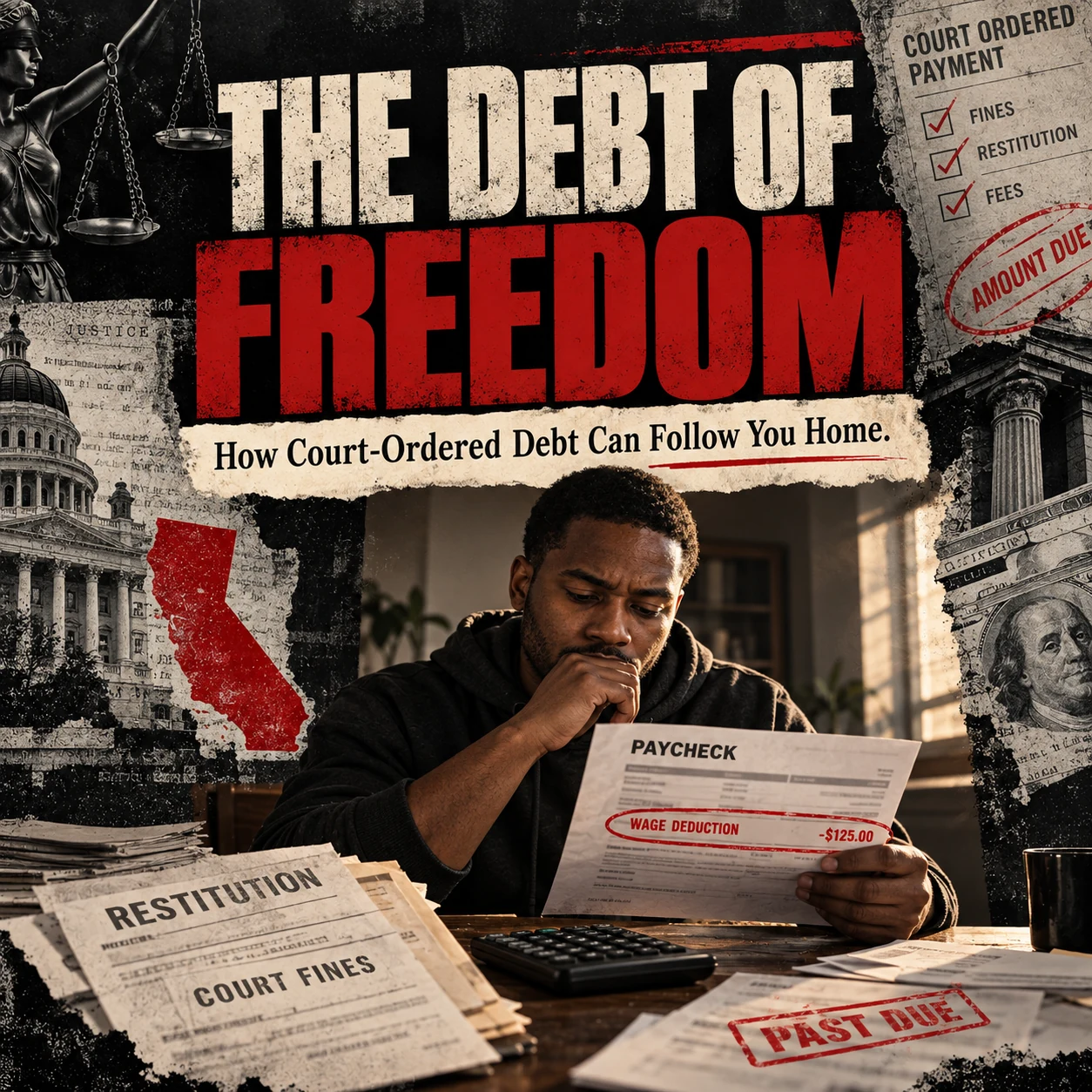
One Balance Can Hide Different Debts
The word restitution is often used as if it means one thing. In California criminal cases, it can refer to at least two very different obligations. A restitution fine is imposed by the court and paid into the state's Restitution Fund. A direct victim restitution order is meant to repay a specific victim for economic losses caused by the offense.
That difference is not technical trivia. It determines whether the 10-year rule applies. AB 1186 changed the collection period for restitution fines. It did not erase direct victim restitution.

The 10-Year Rule: What AB 1186 Actually Changed
California enacted AB 1186 in 2024, and the collection change took effect January 1, 2025. CDCR's implementation guidance says restitution fines and related fees generally become unenforceable and uncollectible 10 years after the date they were imposed. For people whose eligible fines were already more than 10 years old, CDCR began stopping collection in 2025.
The law is narrower than the phrase "restitution expires after 10 years" makes it sound. Direct victim restitution remains collectible until it is fully paid. CDCR also identifies Penal Code section 1202.45 fines as excluded from the 10-year rule.
If your case is old enough to qualify, the most useful documents are usually the sentencing minute order or Abstract of Judgment, because they show when the fine was imposed and what the court ordered.
Direct Victim Restitution Is Different
Direct victim restitution compensates a specific victim for losses tied to the crime—such as medical costs, lost wages, or property loss. California Courts describes a victim restitution order as a court decision requiring the person convicted to repay those losses. Once entered, the victim may use the order to pursue collection.
AB 1186 did not create a 10-year cutoff for these direct orders. That means an older case can contain a restitution fine that is no longer collectible while a separate victim restitution order remains enforceable.
When Court Debt Reaches the Franchise Tax Board
California courts can refer unpaid court-ordered debt to the Franchise Tax Board for collection. FTB says its Court-Ordered Debt program may collect through a paycheck or bank account. If you disagree with the debt, believe it was already paid, completed community service, or have another problem with the underlying balance, FTB directs people back to the court or county listed on the notice.
If the problem is collection hardship rather than the validity of the debt, FTB says to contact its Court-Ordered Debt program when a wage garnishment or bank levy is causing financial hardship. FTB also says people who cannot pay the full court-ordered debt may be able to apply for a payment plan or request that the bill be delayed.
Those are different problems with different doors: the court controls the underlying court balance; the collection agency handles collection activity.
Know What You Owe
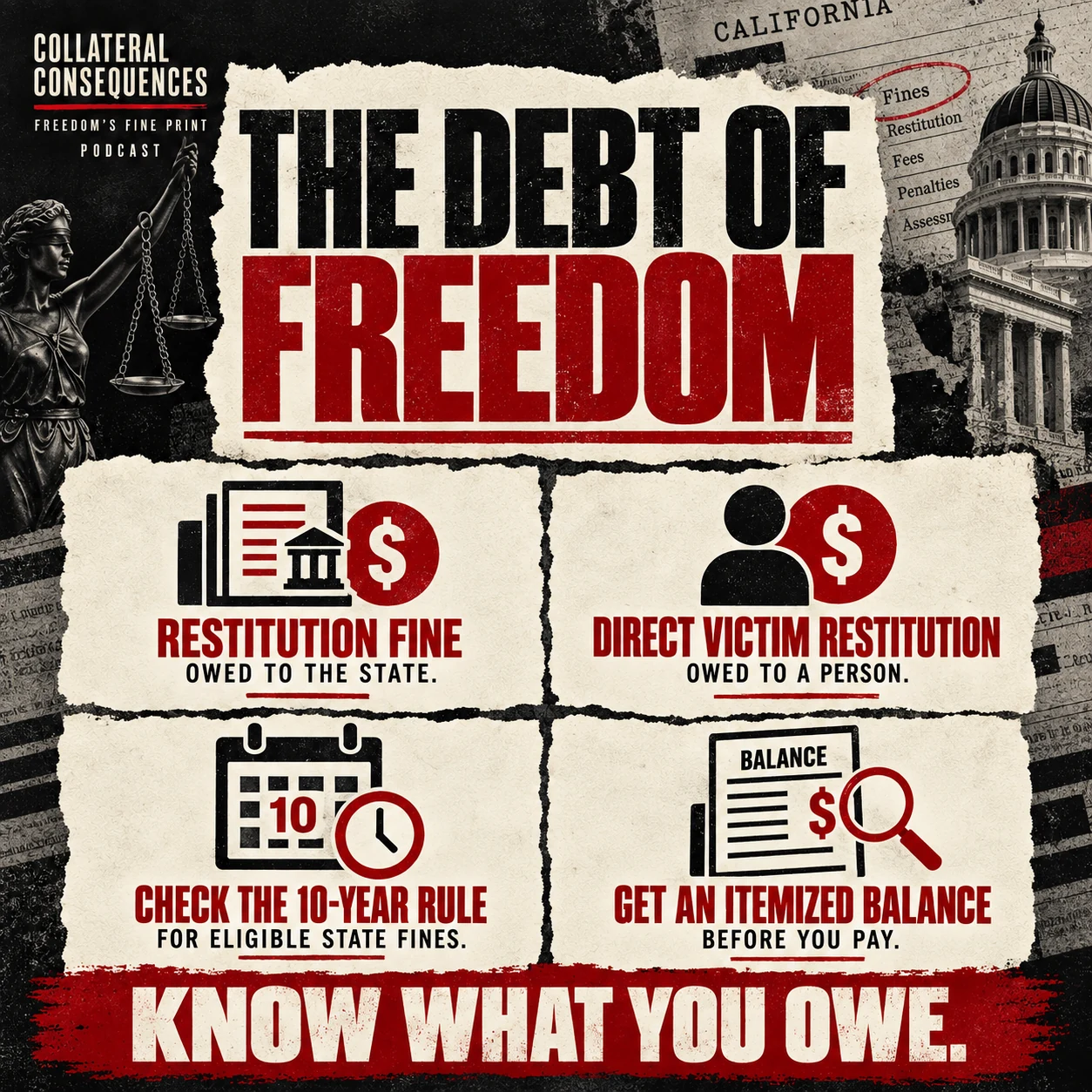
Key distinction: a restitution fine owed to the state is not the same thing as direct victim restitution owed to a person. The 10-year collection rule applies only to qualifying restitution fines.
A 2026 Relief Tool Worth Knowing About
California's MyCitations system is now available through all 58 superior courts for eligible traffic and other infraction cases. The Judicial Branch reports that more than 470,000 ability-to-pay requests had been submitted by the end of 2025. More than 87 percent received at least one form of relief, and courts had reduced more than $115 million in eligible fines and fees.
For those eligible cases, people can ask for a lower fine, a payment plan, more time to pay, or community service. California Courts says the average amount owed in the cases reported fell from $499 to $233 after reductions.
That is useful, but it is important not to overstate it. MyCitations is an ability-to-pay process for eligible infractions. It does not rewrite the rules for victim restitution or every criminal debt.
Five Moves Before You Pay Another Dollar
- Identify the debt. Ask for an itemized balance showing restitution fines, direct victim restitution, fees, assessments, and any other court debt separately.
- Find the date of imposition. Check the sentencing minute order or Abstract of Judgment so you can evaluate whether the AB 1186 10-year rule applies to an eligible restitution fine.
- Check who is collecting. The court, county, CDCR, or FTB may be involved. The right contact depends on the problem you are trying to solve.
- Challenge errors at the source. If you believe the amount is wrong, paid, or otherwise inaccurate, contact the court or county identified on the notice.
- Ask about hardship options. If collection is creating hardship, ask the collecting agency what payment-plan, delay, or hardship process applies. For eligible infractions, MyCitations may offer additional relief.
Debt Should Be Read Like a Court Order, Not a Credit-Card Bill
A court balance can follow someone home for years, but the word debt does not tell you what rights or options apply. Some obligations may reach a statutory collection limit. Some remain enforceable. Some can be challenged because the balance is wrong. Some can be managed through payment or hardship processes.
The practical goal is not to guess which rule applies. It is to identify the obligation, verify the amount, verify the date, and use the process attached to that specific debt.
That is the difference between simply living under the debt and understanding the fine print behind it.
Sacramento Starting Point
2-1-1 Sacramento: use the reentry directory to locate local legal, financial, employment, and support services when court debt is affecting reentry. Dial 2-1-1 or 916-498-1000. Open local reentry resources ↗
Verified Sources & Further Reading
- CDCR — Implementation of Assembly Bill 1186: Changes to Restitution Fines
- California Courts — Order for Victim Restitution (CR-110)
- Franchise Tax Board — Court-Ordered Debt Collections
- Franchise Tax Board — Help With Court-Ordered Debt
- Franchise Tax Board — Payment Plans and Delayed Billing
- California Courts — MyCitations Online Traffic Adjudication Program
- Judicial Branch of California — Adjusting Fines & Fees for Californians in Need
Support Independent Reentry Media
Collateral Consequences turns complicated rules into practical information people can actually use. Your support helps fund research, production, outreach, and future reporting on the barriers that continue after incarceration.
Support Collateral Consequences on Givebutter →
With appreciation to BAVC Media for serving as the fiscal sponsor of Collateral Consequences: Freedom's Fine Print and supporting this independent media project.
Need Reentry Resources?
The Reentry Village connects people with practical resources for housing, employment, healthcare, identification, education, recovery, legal assistance, benefits, transportation, and family stability.
Collateral Consequences: Freedom's Fine Print is hosted by Larenzo and fiscally sponsored by BAVC Media.
Educational and informational content only. This article is not legal advice. Laws, agency guidance, eligibility rules, and collection practices can change. Confirm current information with the relevant court or agency.